
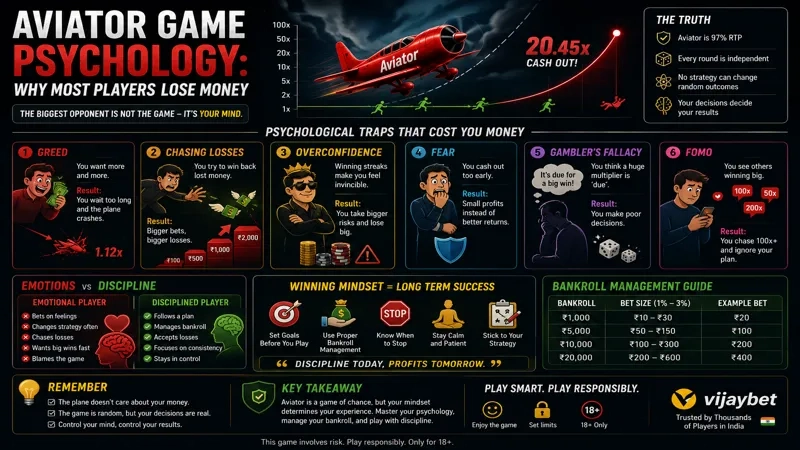
Introduction: The Hidden Factor Behind Aviator Losses
Most Aviator players believe their results are determined entirely by luck, RTP, or strategy. While these factors certainly matter, there is another element that often has a much bigger impact on long-term results: psychology.
The reality is that most players do not lose because they misunderstand the game mechanics. They lose because they make emotional decisions. Fear, greed, impatience, overconfidence, and frustration can quickly turn a winning session into a losing one.
For Indian players using platforms like vijaybet, understanding the psychological side of Aviator can be just as important as understanding multipliers and bankroll management. This guide explores the most common mental mistakes that cause players to lose money and explains how to avoid them.
Why Psychology Matters in Aviator
Aviator is different from many traditional casino games.
Players constantly make decisions such as:
- When to cash out
- How much to bet
- Whether to increase stakes
- Whether to continue after losses
Because every round requires decision-making, emotions can heavily influence results.
Many players on vijaybet discover that their biggest opponent is not the game itself—it is their own mindset.
The Most Common Reason Players Lose: Greed
Greed is one of the biggest bankroll killers in Aviator.
A typical scenario:
- Player cashes out successfully at 2x several times.
- Confidence increases.
- The player decides to wait for 20x.
- The plane crashes at 1.15x.
What started as a disciplined strategy turns into unnecessary risk.
Greed causes players to abandon winning systems in pursuit of unrealistic profits.
Chasing Losses
Another common psychological trap is chasing losses.
Example:
- Lose ₹500
- Increase next bet to ₹1,000
- Lose again
- Increase to ₹2,000
Many players believe a larger bet will recover previous losses.
In reality:
- Risk increases
- Pressure increases
- Decision quality decreases
This behavior is responsible for many of the largest losses seen on vijaybet.
Overconfidence After Winning
Winning can be just as dangerous as losing.
After several successful rounds, players often begin believing:
- They understand the pattern
- They can predict crashes
- Their strategy cannot fail
This confidence frequently leads to:
- Larger bets
- Riskier multipliers
- Poor bankroll management
Aviator’s outcomes remain independent regardless of previous results.
Fear Causes Early Cash-Outs
Not all psychological mistakes involve excessive risk.
Fear can also hurt profitability.
Example:
| Planned Cash Out | Actual Cash Out |
|---|---|
| 2.00x | 1.20x |
| 3.00x | 1.35x |
| 5.00x | 1.50x |
Fear causes players to abandon their strategy whenever the multiplier starts moving.
Over time, this can reduce profitability significantly.
The Gambler’s Fallacy
One of the most dangerous mental traps is the belief that previous results affect future outcomes.
Examples:
- “Five low crashes happened in a row.”
- “A big multiplier must be coming.”
This thinking is known as the Gambler’s Fallacy.
Reality:
- Each Aviator round is independent.
- Previous crashes do not influence future crashes.
- No multiplier is “due.”
Players on vijaybet should always remember that every round starts fresh.
The Illusion of Control
Many players believe they have discovered:
- Secret patterns
- Winning formulas
- Special timing methods
Unfortunately, this often creates a false sense of control.
While bankroll management and discipline matter, no strategy can control the outcome of random events.
Believing otherwise often leads to excessive risk-taking.
Why Predictor Apps Exploit Psychology
Predictor apps remain popular because they appeal to emotions.
They promise:
- Guaranteed profits
- Secret algorithms
- Future crash predictions
These claims attract players who:
- Fear losing
- Want easy profits
- Seek certainty
However, Aviator uses random and provably fair systems.
Predictor apps cannot reliably forecast future outcomes.
FOMO: Fear of Missing Out
Many players experience FOMO.
Example:
- A friend hits 100x.
- A screenshot appears on social media.
- Players begin chasing huge multipliers.
This creates unrealistic expectations.
Most successful players on vijaybet focus on consistent decisions rather than rare jackpot-style moments.
Emotional Decision-Making vs Rational Decision-Making
| Emotional Player | Disciplined Player |
|---|---|
| Chases losses | Accepts losses |
| Changes strategy constantly | Follows a plan |
| Bets based on feelings | Bets based on limits |
| Seeks revenge | Remains patient |
| Focuses on big wins | Focuses on consistency |
Long-term success usually comes from discipline rather than prediction.
Why Bankroll Management Reduces Emotional Mistakes
Good bankroll management helps control emotions.
Recommended guidelines:
| Bankroll | Suggested Bet Size |
|---|---|
| ₹1,000 | ₹10–₹30 |
| ₹5,000 | ₹50–₹150 |
| ₹10,000 | ₹100–₹300 |
Smaller bet sizes reduce stress and improve decision quality.
Many experienced vijaybet players focus on protecting their bankroll first.
The Psychology of Winning Streaks
Winning streaks can create dangerous habits.
Players often begin believing:
- Losses are unlikely
- Their strategy is unbeatable
- Bigger bets are justified
Eventually, variance returns and losses occur.
Successful players treat winning streaks with the same caution as losing streaks.
The Psychology of Losing Streaks
Losing streaks often trigger:
- Frustration
- Anger
- Impulsive betting
- Loss chasing
Professional players respond differently.
They:
- Reduce bet sizes
- Take breaks
- Review performance
- Protect their bankroll
This approach helps prevent emotional decisions.
RTP and Psychology
Aviator has an RTP of approximately 97%.
| Feature | Value |
|---|---|
| RTP | 97% |
| Volatility | Medium |
| Fairness | Provably Fair |
| Game Type | Crash Game |
However, RTP does not protect players from poor psychological decisions.
Many players lose money despite understanding RTP because emotions override logic.
Habits of Successful Aviator Players
Successful players often:
- Set daily limits
- Use predefined cash-out targets
- Avoid chasing losses
- Ignore predictor apps
- Focus on consistency
- Accept losing sessions
These habits create a healthier long-term approach.
Practical Mental Tips Before Every Session
Ask yourself:
- What is my budget?
- What is my maximum loss?
- What is my profit target?
- Will I stop when I reach either limit?
Having answers before starting reduces emotional decision-making.
Why Most Players Ultimately Lose Money
Most losses are caused by:
- Greed
- Fear
- Overconfidence
- Chasing losses
- Ignoring bankroll management
- Unrealistic expectations
The game itself is often not the problem.
Player behavior is.
Final Verdict
The biggest factor separating winning and losing Aviator players is often psychology rather than strategy. Most players understand how multipliers work, but far fewer understand how emotions influence their decisions. Greed, fear, overconfidence, and loss chasing can quickly destroy even the best bankroll management plan.
Players on vijaybet who focus on discipline, emotional control, and realistic expectations typically enjoy a much more sustainable experience. While no strategy can eliminate risk, mastering your psychology can dramatically improve your decision-making and help you avoid the mistakes that cause most players to lose money.
FAQ
Why do most Aviator players lose money?
Poor emotional control and bad bankroll management are the most common reasons.
Is greed a major factor in losses?
Yes, many players abandon disciplined strategies while chasing larger multipliers.
What is loss chasing?
Increasing bets to recover previous losses.
Can psychology affect results?
Yes, emotional decisions often lead to unnecessary risk.
What is the Gambler’s Fallacy?
The belief that previous outcomes influence future results.
Do predictor apps work?
No, they cannot reliably predict future crash points.
How can I reduce emotional betting?
Set limits and follow a predefined strategy.
Does RTP guarantee profits?
No, RTP reflects long-term averages only.
What is the most important skill in Aviator?
Discipline and bankroll management.
Can psychology improve long-term performance?
Yes, emotional control often leads to better decision-making.